***
Welcome to the Power Writers Report, our weekly update, packed full of powerful writing tips, productivity tools, platform-building strategies,
author best practices, resources, and free stuff.
If
you find this useful, forward it to a friend.
Click
here
to subscribe to the weekly Power Writers Report.
Click
here
to schedule an author strategy session with me.
Where Does Your Allegiance Lie?
At the risk of sounding like a broken record, I keep coming back to this truth: Every author must be more committed to their audience than they are to their message or story.
READ. THAT. AGAIN.
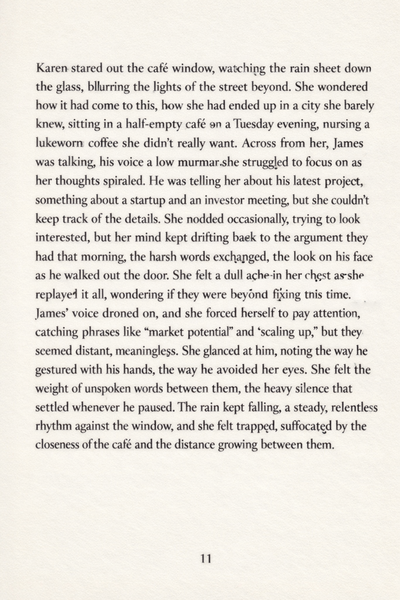
You don't want to overload your manuscript with endless lines of text. Their brains simply can't handle it.
So today, we're going to keep it simple. Here are four principles that will help you know where to make your paragraph breaks so you don't wear down your
readers.
1. Break When the Speaker Changes
This is the simplest rule—and the most violated.
Every new speaker deserves a new
paragraph.
Not just because grammar textbooks say so, but because the reader’s brain needs visual cues.
Dialogue is white space. And white space is oxygen.
Even in nonfiction, if you quote someone, isolate it.
Your page should look readable before it’s ever read.
Ask yourself: If someone flipped to this page in a bookstore, would it
feel inviting—or intimidating?
Remember, people skim before they commit.
And yes, they will skim your book.
That’s not disrespect. That’s human nature.
2. Break When the Idea Shifts
This is where writers struggle most.
You may think you’re
elaborating. The reader may feel like you're wandering.
A paragraph should generally carry one dominant idea. When that idea shifts—even subtly—start fresh.
Here’s a simple test. Read your paragraph out loud.
Where do you naturally pause?
Where do you take a breath?
That breath is often where your paragraph break
belongs.
Another powerful technique: try summarizing the paragraph in one sentence without using "and," or "but". If you can’t, you probably have more than one idea in there.
Especially in nonfiction, clarity builds authority. When
your structure is clean, you appear thoughtful, disciplined, and confident.
Long, meandering paragraphs signal the opposite—even if the content is brilliant.
3. Break for Emphasis
This is where art enters the room.
A revelation deserves space.
A powerful sentence deserves isolation.
A moment of transformation deserves its own line.
See what I'm doing here?
Look at memoirs by writers like Matthew McConaughey in Greenlights. Notice how often key
realizations stand alone.
That’s not accidental.
White space creates gravitas.
When you give a sentence
its own paragraph, you’re telling the reader:
Pay attention.
This matters.
Too many writers bury their best insights inside dense blocks of text. Don’t hide your gold.
Display it!
4. Design for the Skimmer
“Mike, I don’t want people skimming my book. I want them to read it.”
I understand.
But here’s the truth: skimming is the gateway to reading.
When someone picks up your book—whether in a bookstore, at a conference, or on Amazon—they flip through it.
They look at:
- The table of contents
- Chapter titles
- Subheads
- Paragraph shape
- Sentence length
If your book looks dense, it feels like work.
If it looks spacious, it feels approachable.
This applies to all age groups. Our brains are constantly looking for
relief. It’s human nature.
Shorter paragraphs don’t mean dumbing down your ideas.
They mean respecting your reader’s time.
I’ll leave you with this:
The engineer I mentioned earlier eventually pared down his manuscript to 40,000 words and broke the paragraphs into smaller chunks—with the help of another coach (I didn’t have time to work with him). The result?
The book sold 30,000 copies and won multiple awards.
That’s what publishing is about: reader-centric writing.
If you’re wondering whether your manuscript is inviting—or overwhelming—don’t guess.
Let’s look at it together.
👉Schedule a free author strategy session with me by clicking below: